
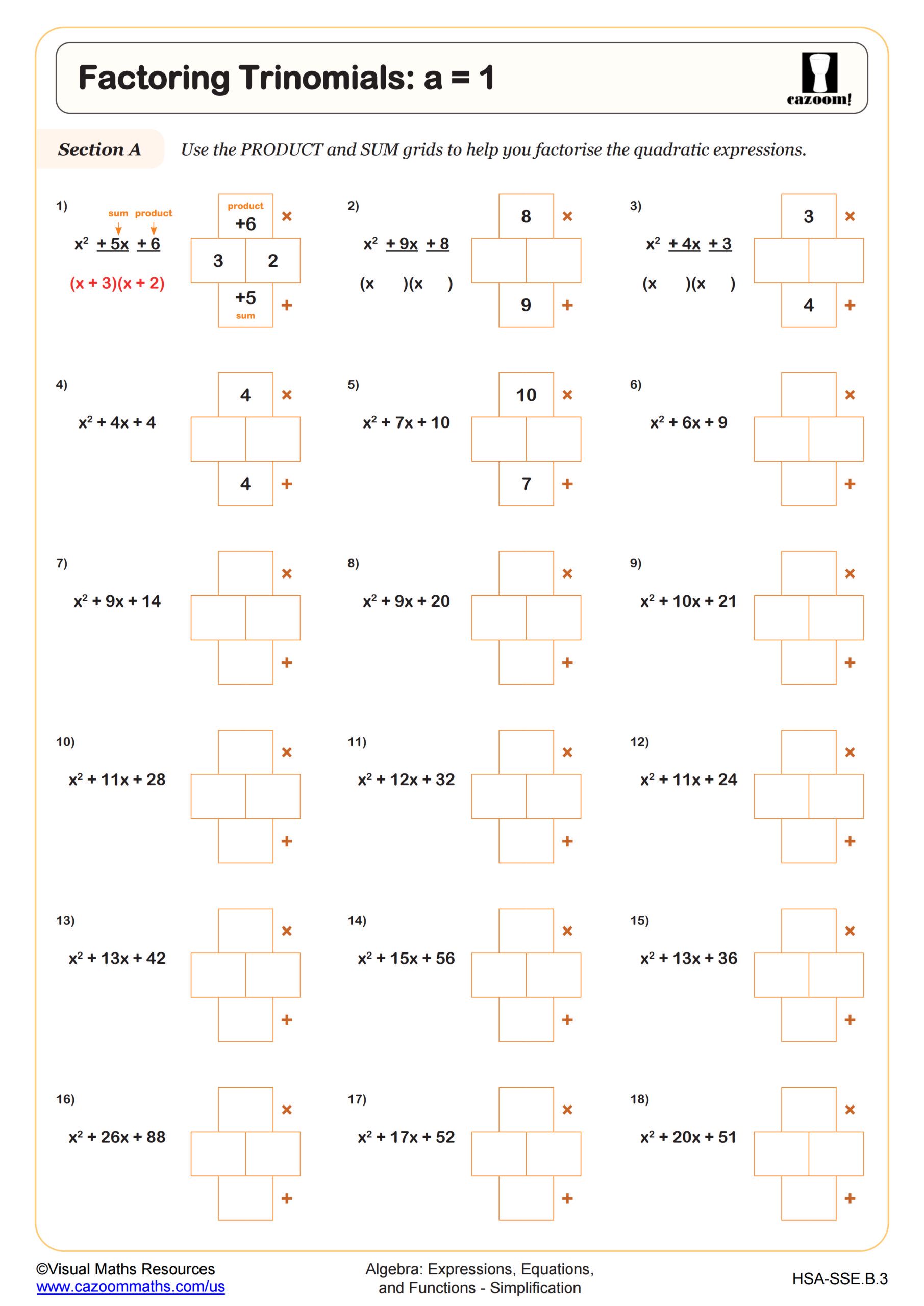
If you’ve ever stared at a math problem and felt like you were deciphering ancient hieroglyphs, you’re not alone. I remember my first encounter with factoring numbers—specifically, working through a Factoring Sheet 1 100. It was a mix of frustration and fascination. Factoring, the process of breaking down numbers into their prime components, is a foundational skill in mathematics. But let’s be honest: it’s not always intuitive. Whether you’re a student, a teacher, or just someone brushing up on math, understanding how to factor numbers from 1 to 100 can feel like unlocking a secret code. Here’s what I’ve learned from years of practice and teaching.
Why Factoring Matters
Factoring isn’t just an academic exercise. In my experience, it’s a skill that pops up in unexpected places. From simplifying fractions in algebra to understanding patterns in number theory, factoring is the backbone of many mathematical concepts. For instance, when I was working on a project involving cryptography, I realized that prime factorization is at the heart of secure data encryption. Even in everyday life, factoring helps with tasks like dividing items equally or understanding ratios. It’s a tool that, once mastered, becomes second nature.
Breaking Down the Factoring Sheet 1 100
The Factoring Sheet 1 100 is essentially a list of numbers from 1 to 100, each broken down into its prime factors. For example, the number 12 factors into 2 × 2 × 3. Sounds simple, right? But as you move up the number line, things get trickier. Take 72, for instance. Its prime factorization is 2 × 2 × 2 × 3 × 3. I’ve found that the key to mastering this is consistency and practice. Start with smaller numbers and gradually work your way up. Use tools like factor trees or division methods to keep things organized.
Common Pitfalls to Avoid
One mistake I often see is skipping prime numbers. Remember, prime numbers like 7, 11, or 13 are their own factors—they can’t be broken down further. Another common error is forgetting to check for repeated factors. For example, 48 is often incorrectly factored as 2 × 2 × 2 × 6 instead of 2 × 2 × 2 × 2 × 3. Always double-check your work to ensure accuracy.
Practical Tips for Factoring
Here’s the thing: factoring doesn’t have to be a chore. Over time, I’ve developed a few strategies that make the process smoother. First, start with the smallest prime number, 2, and divide as many times as possible. Then move to the next smallest prime, 3, and so on. This systematic approach reduces errors. Second, use a Factoring Sheet 1 100 as a reference but don’t rely on it entirely. The goal is to internalize the patterns, not memorize them.
📌 Note: If you’re struggling with larger numbers, break them down into smaller, more manageable parts. For example, factor 84 as (2 × 42) first, then break down 42 further.
Tools and Resources
While practicing, I’ve found that using a factoring calculator can be helpful for checking answers. However, don’t let it replace manual practice. A tool I highly recommend is a blank factoring sheet where you fill in the factors yourself. This reinforces the process and helps you spot patterns. For visual learners, drawing factor trees can also be incredibly useful.
Real-World Applications
Honestly, factoring isn’t just for math class. I’ve seen it applied in fields like engineering, where understanding material quantities is crucial. For example, if you’re designing a structure and need to calculate the number of bricks required, factoring can help ensure you’re working with whole numbers. Even in finance, factoring is used to simplify ratios and percentages. It’s a versatile skill that extends far beyond the classroom.
| Number | Prime Factorization | Application Example |
|---|---|---|
| 12 | 2 × 2 × 3 | Dividing items equally among groups |
| 48 | 2 × 2 × 2 × 2 × 3 | Calculating material quantities in construction |
| 72 | 2 × 2 × 2 × 3 × 3 | Simplifying ratios in finance |
This is where it gets interesting: once you’ve mastered factoring, you’ll start noticing its applications everywhere. It’s like learning a new language—suddenly, the world makes a lot more sense. So, the next time you’re faced with a Factoring Sheet 1 100, don’t dread it. See it as an opportunity to sharpen a skill that will serve you in ways you might not even realize yet.
Here’s my final thought: factoring isn’t just about breaking down numbers—it’s about building a foundation for problem-solving. Whether you’re tackling a math problem or a real-world challenge, the ability to see things in their simplest form is invaluable. So grab your pencil, start with 1, and work your way up. You’ll be surprised at how quickly it becomes second nature.
Related Terms:
- factoring sheet 1 100 printable
- factoring sheet 1 100 blanks
- factoring sheet 1 100 multiplication
- 1-100 numbers
- 1-100 number bangla
- 1-100 random number generator


